
Naturehike ULG Down Sleeping Bag — 800FP White Goose Down, 400 / 700 / 1,000 g Fill, Comfort −4 to −15°C


Naturehike ULG Down Sleeping Bag 800FP White Goose Down, 400 / 700 / 1,000 g Fill, Comfort −4 to −15°C
Naturehike's goose-down mummy in three warmths, all in one roomy 210 cm cut.
- Down
- 400–1,000 g
- Fill power
- 800
- Comfort
- −4 to −15°C
- Free shipping Australia-wide: 1–3 business days to dispatch, then 10–20 business days on the way. Worth the wait, but order a month before your trip. Shipping
- 30-day returns. We pay the postage if it's faulty or not as described. Returns
- Every figure on this page is the maker's own, and labelled as such.
The ULG is Naturehike's goose-down mummy: 800 fill-power white goose down in a 20D nylon shell, 210 × 80 cm, with a choice of 400 g, 700 g or 1,000 g of fill.
Naturehike rates them at comfort −4°C (ULG400), −10°C (ULG700) and −15°C (ULG1000). Those are the maker's own figures, so compare on fill weight too. Approximate weights: 880 g, 1,200 g and 1,535 g.
Same bag, three amounts of down.
- Best for
- Campers who want a durable goose-down bag and don't mind a few hundred grams: car camping, hut trips, and winter in the ULG1000.
- Think twice if
- Makers rate very differently: Naturehike rates the ULG400 at comfort −4°C, while Black Ice rates its G400, with the same 400 g of down, at 10°C. That is why we tell you to compare grams of down first. The 20D shell also makes it the heaviest bag in its class here.
Pick the fill
400, 700 or 1,000 g of 800FP white goose down in the same 210 × 80 cm bag.
Long and roomy
At 210 cm, most people won't need a long size.
A 20D shell
Tougher than 10D, which is why the ULG400 weighs 880 g against the Z400's 640 g.
Warm enough for your trip?
Plan on the “warm to” figure: the maker's comfort rating or, where their labels are unclear, the safest of their figures. If you sleep cold, or you're not sure, add 5°C. And if you're torn between two bags, take the warmer one: a bag that's too warm, you unzip; one that's too cold, you can't fix at 2 am.
Compare it with every bag we sell- ULG400 Comfortable to about −4°C If you sleep cold, about 1°C
- ULG700 Comfortable to about −10°C If you sleep cold, about −5°C
- ULG1000 Comfortable to about −15°C If you sleep cold, about −10°C
Is it the right bag for your trip?
Pick the coldest night you expect. We'll show every bag and quilt that's warm enough, lightest first, and mark this one if it makes the cut.
- Wind Hard Dusk Light Warm to 10°C 190 g A$279
- Wind Hard Tiny Warm to 7°C 290 g A$269
- Wind Hard Dusk Warm to 4°C 325 g A$279
- Aegismax Nano 2 Warm to 5°C 350 g A$279
- Aegismax G1 Warm to 3°C 380 g A$299
- Black Ice E400 Warm to 15°C 400 g A$319
- Black Ice G400 Warm to 10°C 400 g A$299
- Black Ice Z400 Warm to 5°C 400 g A$319
- Naturehike ULG400This bag Warm to −4°C 400 g A$319
- Wind Hard Dusk II Warm to 1°C 436 g A$299
- Aegismax M3 Warm to 0°C 500 g A$319
- Aegismax Ultra Future I Warm to 0°C 520 g A$349
- Wind Hard Tiny Pro Warm to −2°C 550 g A$299
- Aegismax G2 Warm to −2°C 664 g A$349
- Black Ice E700 Warm to 7°C 700 g A$319
- Black Ice G700 Warm to 3°C 700 g A$349
- Black Ice Z700 Warm to −2°C 700 g A$349
- Naturehike ULG700This bag Warm to −10°C 700 g A$379
- Aegismax Ultra Future II Warm to −10°C 830 g A$349
- Black Ice E1000 Warm to −2°C 1,000 g A$349
- Black Ice G1000 Warm to −7°C 1,000 g A$479
- Black Ice Z1000 Warm to −11°C 1,000 g A$399
- Naturehike Arctic-17 Warm to −17°C 1,000 g A$449
- Naturehike ULG1000This bag Warm to −15°C 1,000 g A$399
- Naturehike Arctic-23 Warm to −23°C 1,300 g A$549
bags and quilts are warm enough. They're sorted lightest first, so the top one is the lightest that will do the job.
Read the full guide: trips, safety and what else to pack
Plan for the coldest night
Hills, valleys and inland camps get much colder than the forecast for the nearest town. Check the overnight low for where you'll actually sleep.
If in doubt, go warmer
Being too cold at night isn't just a bad night's sleep. A long, cold night in a bag that's too thin can tip into hypothermia, and there's no fixing it at 2 am.
The mat matters as much as the bag
Down underneath you is crushed flat, so the ground steals your heat. Below freezing, use an insulated mat with an R-value of 4 or more.
Help the bag help you
Change into dry clothes, eat something before bed, and wear a beanie. A bag holds warmth in, but it can't make it.
Which one?
| Model | Down | Weight | Comfort | Limit | Packed | Price |
|---|---|---|---|---|---|---|
| ULG400 | 400 g | 880 g | −4°C | −8°C | 19 × 38 cm | A$319 |
| ULG700 | 700 g | 1,200 g | −10°C | −15°C | 21 × 40 cm | A$379 |
| ULG1000 | 1,000 g | 1,535 g | −15°C | −20°C | 23 × 42 cm | A$399 |
Naturehike calls these ratings comfort, restriction and limit. Weights are approximate (maker).
Where it sits among our 25 bags and quilts, by grams of down
Choose by your coldest nightHighlighted: ULG400 (400 g), ULG700 (700 g), ULG1000 (1,000 g). The other marks are the rest of our 25 bags and quilts.
The numbers
Taken from Naturehike's own listing and spec cards for this exact model. Where the maker doesn't publish something, the line is left out rather than guessed.
| Down | 800 fill-power white goose down |
|---|---|
| Temperature (maker) | ULG400: comfort −4°C, limit −8°C, extreme −14°C ULG700: comfort −10°C, limit −15°C, extreme −26°C ULG1000: comfort −15°C, limit −20°C, extreme −32°C |
| Size | 210 × 80 cm |
| Shell and lining | 20D nylon |
| Construction | Mummy cut, collar and side wind barriers, 3D zip draft tube |
| Brand | Naturehike |
“Warm to” is the figure we plan on: the maker's comfort rating or, where their labels are unclear, the warmest figure they publish. Temperature ratings on this page are Naturehike's own figures, not independently lab-tested. Brands like Sea to Summit pay for an independent EN/ISO 23537 test; these makers don't publish one. So compare on fill weight and fill power first: they're physical quantities. How to read them
Complete your sleep system
A bag is half of a warm night. Here's what else makes it work, and what people usually add.
-
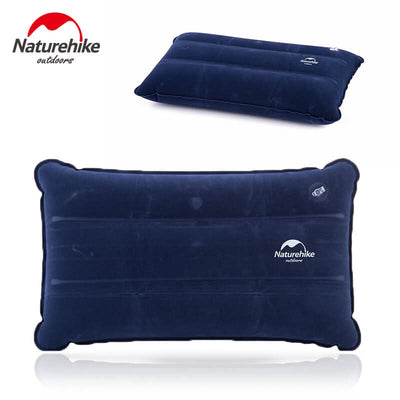 Inflatable Camp Pillow
An 85 g pillow that folds flat and stays put on your mat.
-
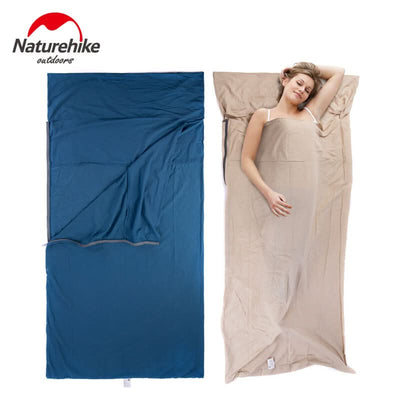 Cotton Sleeping Bag Liner
Keeps a down bag clean, and works on its own in huts and hostels.
A mat rated for the season
The ground takes more heat than the air, and down underneath you is crushed flat. As a rough guide: an R-value of about 2 for summer, 3 to 4 for three seasons, and 5 or more on snow.
A way to keep it dry
Wet down stops insulating. Pack the bag in its compression sack inside a dry bag or pack liner, and air it out when you reach camp.
Questions
Which size should I buy?
Are the temperature ratings lab-tested?
Comfort, limit, extreme: which one do I use?
How do I store and wash a down bag?
When will it arrive?
Will my order arrive in one parcel?
Will I pay duty or GST on delivery?
What if it isn't right?
Three numbers, in this order
Most listings lead with a temperature and a price. Those are the two least reliable numbers on the page. Read these first.
- 1
Fill weight: grams of down
How much insulation is actually in the bag. A listing that hides it is hiding the cost of the product. As a rough guide for Australia: 400–500 g is a summer-to-shoulder bag, around 700 g takes you below freezing, and 1,000 g is for snow.
- 2
Fill power: 700, 800, 850
The quality of the down: how much it lofts per gram. Higher fill power gives the same warmth for less weight and a smaller pack. It doesn't mean warmer on its own: 300 g of 800FP down is still a summer bag.
- 3
Total weight and packed size
What you actually carry. Compare it with the fill weight: a bag with 700 g of down that weighs 970 g is spending 270 g on fabric and zips, which is about right for a 10D shell.
Temperature ratings come last, and only once you know who measured them. EN/ISO 23537 means an independent lab test. Every rating in this shop is the maker's own: Aegismax says it follows the EN 13537 method, and Black Ice and Naturehike don't say. The FAQ has the long version.
More from this shelf
-

Black Ice
E Series Envelope Down Sleeping Bag
- Down
- 400–1,000 g
- Fill power
- 700+
- Shape
- Envelope
fromA$319
-

Aegismax
G Series Down Sleeping Bag
- Down
- 380 / 664 g
- Fill power
- 800
- Comfort
- 3 / −2°C
fromA$299
-

Naturehike
Arctic Alpine Down Sleeping Bag
- Down
- 1,000–1,300 g
- Fill power
- 850
- Comfort
- −17 / −23°C
fromA$449
-

Aegismax
Ultra Future Down Sleeping Bag
- Down
- 520–950 g
- Fill power
- 800
- Comfort
- 0 / −10°C
fromA$349


- Free shipping Australia-wideThe price on the tag is the price you pay. No duty or GST on delivery under A$1,000.
- Every number publishedFill weight, fill power and weight on every bag, and a note wherever the maker's figures are unclear.
- 30-day returnsUnused and in its packaging. We pay the postage if anything is faulty or not as described.
- Replies within 24 hoursEmail us Monday to Friday and a person answers, not a bot or a call centre.