
Winter Goose Down Envelope Bag — 600 to 1,000 g of 90% Goose Down, 210 × 80 cm, Opens Into a Quilt


Down Sleeping Bag Winter Goose Down Envelope Bag
A roomy winter envelope with a hood: up to 1,000 g of goose down, and it still opens flat into a quilt.
- Down
- 600–1,000 g
- Bag weight
- 1.2–1.6 kg
- Warm to
- +5 to −2°C
- Tracked delivery Australia-wide, A$19.95 on orders from A$100 (A$9.95 under): 1–3 business days to dispatch, then 10–20 business days on the way. Order a month before your trip. Shipping
- 30-day returns. We pay the postage if it's faulty or not as described. Returns
- Every figure on this page is the maker's own or our clearly labelled guide. No made-up lab ratings.
A 210 × 80 cm envelope-style sleeping bag with a drawcord hood, filled with 600, 800 or 1,000 g of 90% goose down. It weighs 1.2 to 1.6 kg, has a 320T water-repellent nylon shell, and opens flat into a quilt.
Room to sleep like you do at home, even in winter.
- Best for
- Winter car camping, cabins and caravans, and sleepers who hate mummy bags.
- Think twice if
- At 1.2 to 1.6 kg, it's a car-camping bag. For carrying on a hike, choose a mummy bag.
Up to 1,000 g of down
Warm enough for frosty car-camping nights.
A hood on an envelope
The drawcord hood keeps your head warm, which most rectangular bags can't.
Opens into a quilt
Unzip it flat on warm nights or at home.
Warm enough for your trip?
Plan on the “warm to” figure: our own cautious guide, or the maker's comfort rating where that's what we quote. If you sleep cold, or you're not sure, add 5°C. And if you're torn between two bags, take the warmer one: a bag that's too warm, you unzip; one that's too cold, you can't fix at 2 am.
Compare it with every bag we sell- Winter envelope 600 g Comfortable to about 5°C If you sleep cold, about 10°C
- Winter envelope 800 g Comfortable to about 1°C If you sleep cold, about 6°C
- Winter envelope 1000 g Comfortable to about −2°C If you sleep cold, about 3°C
Is it the right bag for your trip?
Pick the coldest night you expect. We'll show every bag and quilt that's warm enough, lightest first, and mark this one if it makes the cut.
- UL250 Warm to 15°C 250 g A$249
- Quilt 260 g Warm to 12°C 260 g A$329
- 10D goose 400 g Warm to 8°C 400 g A$369
- 95% envelope 400 g Warm to 10°C 400 g A$259
- Black Snow 400 g Warm to 8°C 400 g A$239
- Cozy 300 Warm to 3°C 400 g A$299
- Envelope 400 g Warm to 10°C 400 g A$229
- Long 225 cm 400 g Warm to 8°C 400 g A$319
- Mummy 400 g Warm to 8°C 400 g A$259
- Oversized 400 g Warm to 8°C 400 g A$249
- Letu M 450 g Warm to 7°C 450 g A$599
- Quilt 500 g Warm to 5°C 500 g A$449
- 95% envelope 600 g Warm to 5°C 600 g A$289
- Envelope 600 g Warm to 5°C 600 g A$259
- Mummy 600 g Warm to 3°C 600 g A$289
- Oversized 600 g Warm to 3°C 600 g A$279
- Winter envelope 600 gThis bag Warm to 5°C 600 g A$249
- Cozy 600 Warm to 1°C 630 g A$329
- 10D goose 700 g Warm to 2°C 700 g A$449
- Black Snow 700 g Warm to 2°C 700 g A$279
- Letu M 700 g Warm to 1°C 700 g A$729
- Long 225 cm 700 g Warm to 2°C 700 g A$369
- 95% envelope 800 g Warm to 1°C 800 g A$329
- Mummy 800 g Warm to −1°C 800 g A$329
- Oversized 800 g Warm to −1°C 800 g A$319
- Winter envelope 800 gThis bag Warm to 1°C 800 g A$269
- Letu M 950 g Warm to −4°C 950 g A$819
- 10D goose 1000 g Warm to −5°C 1,000 g A$549
- 95% envelope 1000 g Warm to −2°C 1,000 g A$359
- AM1000 Warm to −3°C 1,000 g A$279
- Black Snow 1000 g Warm to −5°C 1,000 g A$329
- Long 225 cm 1000 g Warm to −5°C 1,000 g A$439
- Mummy 1000 g Warm to −5°C 1,000 g A$369
- Oversized 1000 g Warm to −5°C 1,000 g A$359
- Winter envelope 1000 gThis bag Warm to −2°C 1,000 g A$299
- 95% envelope 1200 g Warm to −4°C 1,200 g A$399
- Letu M 1200 g Warm to −8°C 1,200 g A$899
- Mummy 1200 g Warm to −8°C 1,200 g A$399
- Oversized 1200 g Warm to −8°C 1,200 g A$399
- 10D goose 1300 g Warm to −9°C 1,300 g A$649
- Black Snow 1300 g Warm to −9°C 1,300 g A$379
- Long 225 cm 1300 g Warm to −9°C 1,300 g A$499
- Extreme 1,500 g Warm to −10°C 1,500 g A$339
- Double 1,800 g Warm to 3°C 1,800 g A$549
- Double 2,000 g Warm to 1°C 2,000 g A$579
- Extreme 2,000 g Warm to −13°C 2,000 g A$379
of our bags and fill weights will keep you warm enough. Lightest first, so the top one is the lightest that will do the job.
Read the full guide: trips, safety and what else to pack
Plan for the coldest night
Hills, valleys and inland camps get much colder than the forecast for the nearest town. Check the overnight low for where you'll actually sleep.
If in doubt, go warmer
Being too cold at night isn't just a bad night's sleep. A long, cold night in a bag that's too thin can tip into hypothermia, and there's no fixing it at 2 am.
The mat matters as much as the bag
Down underneath you is crushed flat, so the ground steals your heat. Below freezing, use an insulated mat with an R-value of 4 or more.
Help the bag help you
Change into dry clothes, eat something before bed, and wear a beanie. A bag holds warmth in, but it can't make it.
Which one?
| Down fill | Bag weight | Comfortable to (our guide) | Price |
|---|---|---|---|
| 600 g | 1,200 g | +5°C | A$249 |
| 800 g | 1,400 g | +1°C | A$269 |
| 1,000 g | 1,600 g | −2°C | A$299 |
Where it sits among every bag we sell, by grams of down
Choose by your coldest nightHighlighted: Winter envelope 600 g (600 g), Winter envelope 800 g (800 g), Winter envelope 1000 g (1,000 g). The other marks are our other bags and fill weights.
The numbers
Taken from the maker's own listing and spec cards for this exact model; anything marked our guide is ours. Where the maker doesn't publish something, the line is left out rather than guessed.
| Down | 90% white goose down (maker's figure, not independently tested): 600, 800 or 1,000 g |
|---|---|
| Whole-bag weight | 600 g fill: about 1,200 g 800 g fill: about 1,400 g 1,000 g fill: about 1,600 g (maker's figures) |
| Comfortable to (our guide) | 600 g: about +5°C 800 g: about +1°C 1,000 g: about −2°C |
| Maker's range | 600 g: 0 to 15°C, extreme −5°C 800 g: −5 to 10°C, extreme −10°C 1,000 g: −10 to −5°C, extreme −15°C |
| Size | 210 × 80 cm, rectangular, with a drawcord hood |
| Shell and lining | 320T tear-resistant nylon, water-repellent; 320T polyester pongee lining |
| Packed | 600 g: about 18 × 22 cm 800 g: about 19 × 25 cm 1,000 g: about 20 × 26 cm |
“Warm to” is the figure we'd plan on: our own cautious guide, or the maker's comfort rating where that's what the table quotes. About the temperatures: Our guide, not a lab rating. It is set on the cautious side because nobody has lab-tested this down. Brands like Sea to Summit pay for an independent EN/ISO 23537 test; nobody has done that for this bag, and we won't pretend otherwise. So compare on grams of down and bag weight first: they're physical quantities. How to read them
Complete your sleep system
A bag is half of a warm night. Here's what else makes it work, and what people usually add.
-
 10 cm Self-Inflating Camp Mat
Ten centimetres of air under you and a pillow built in: the car-camping mat that feels like a mattress.
-
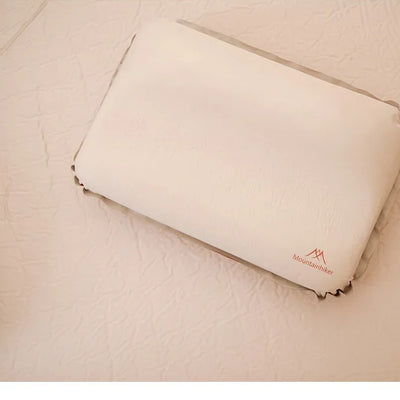 Self-Inflating Foam Pillow
Open the valve and it fills itself: a foam camp pillow that feels like one from home.
-
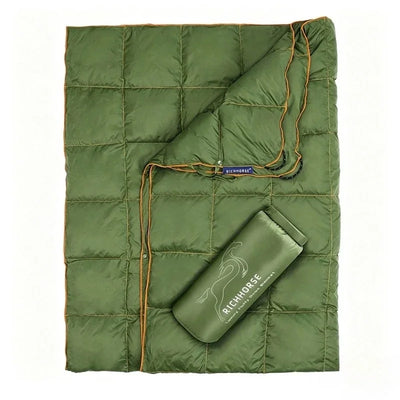 Down Camp Blanket
A light, packable down blanket for the campfire, the car and the couch.
-
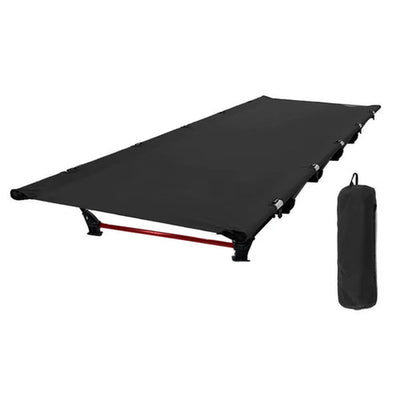 Ultralight Camp Cot
Sleep off the cold, lumpy ground: a low aluminium cot that packs smaller than a sleeping bag.

A mat rated for the season
The ground takes more heat than the air, and down underneath you is crushed flat. As a rough guide: an R-value of about 2 for summer, 3 to 4 for three seasons, and 5 or more on snow.
A way to keep it dry
Wet down stops insulating. Pack the bag in its compression sack inside a dry bag or pack liner, and air it out when you reach camp.
Questions
Which fill should I choose?
Can two bags zip together?
How do I store it?
Which size should I buy?
Are the temperature ratings lab-tested?
Comfort, limit, extreme: which one do I use?
How do I store and wash a down bag?
When will it arrive?
Will my order arrive in one parcel?
Will I pay duty or GST on delivery?
What if it isn't right?
More from this shelf
-

Down Sleeping Bag
Goose Down Mummy Bag
- Down
- 400–1,200 g
- Bag weight
- 0.87–1.7 kg
- Warm to
- +8 to −8°C
fromA$259
-

Down Sleeping Bag
Black Snow 800FP Mummy
- Down
- 400–1,300 g
- Bag weight
- 0.85–1.75 kg
- Warm to
- +8 to −9°C
fromA$239
-

Down Sleeping Bag
Alpine Guest Letu Ultralight
- Down
- 410–1,330 g, 800+FP
- Bag weight
- 655 g–1.6 kg
- Shell
- 10D / 7D
fromA$569
-

Down Sleeping Bag
Goose Down Envelope Bag
- Down
- 400 or 600 g
- Bag weight
- 725–860 g
- Warm to
- +10 / +5°C
fromA$229


- Tracked delivery Australia-wideA$9.95 on orders under A$100, A$19.95 from A$100. No duty or GST to pay on delivery.
- Every number publishedGrams of down and weight on every bag, the R-value wherever the maker publishes one, capacity and weight on every pot, and a note wherever the maker's figures are unclear.
- 30-day returnsUnused and in its packaging. We pay the postage if anything is faulty or not as described.
- Replies within 24 hoursEmail us Monday to Friday and a person answers, not a bot or a call centre.